
The Beauty Growth Paradox of 2026: A Growing Market Is Not a Growth Strategy
Why the global cosmetics industry continues to expand while growth becomes increasingly selective across brands, categories, and distribution channels.
By IPEGLOR NEXUS™ Editorial Team
A Market Growing at Different Speeds
The global beauty industry is growing. Yet growth is becoming increasingly difficult to capture.
This is one of the defining contradictions of the cosmetics market in 2026.
Consumer spending remains resilient across several major beauty categories. Prestige and mass-market products are both attracting demand. Dermatological skincare continues to demonstrate strong momentum, while digital commerce is reshaping the competitive landscape.
At the same time, established brands are reporting uneven results, and strong category growth is not necessarily translating into stronger performance for every participant.
The numbers illustrate the contrast.
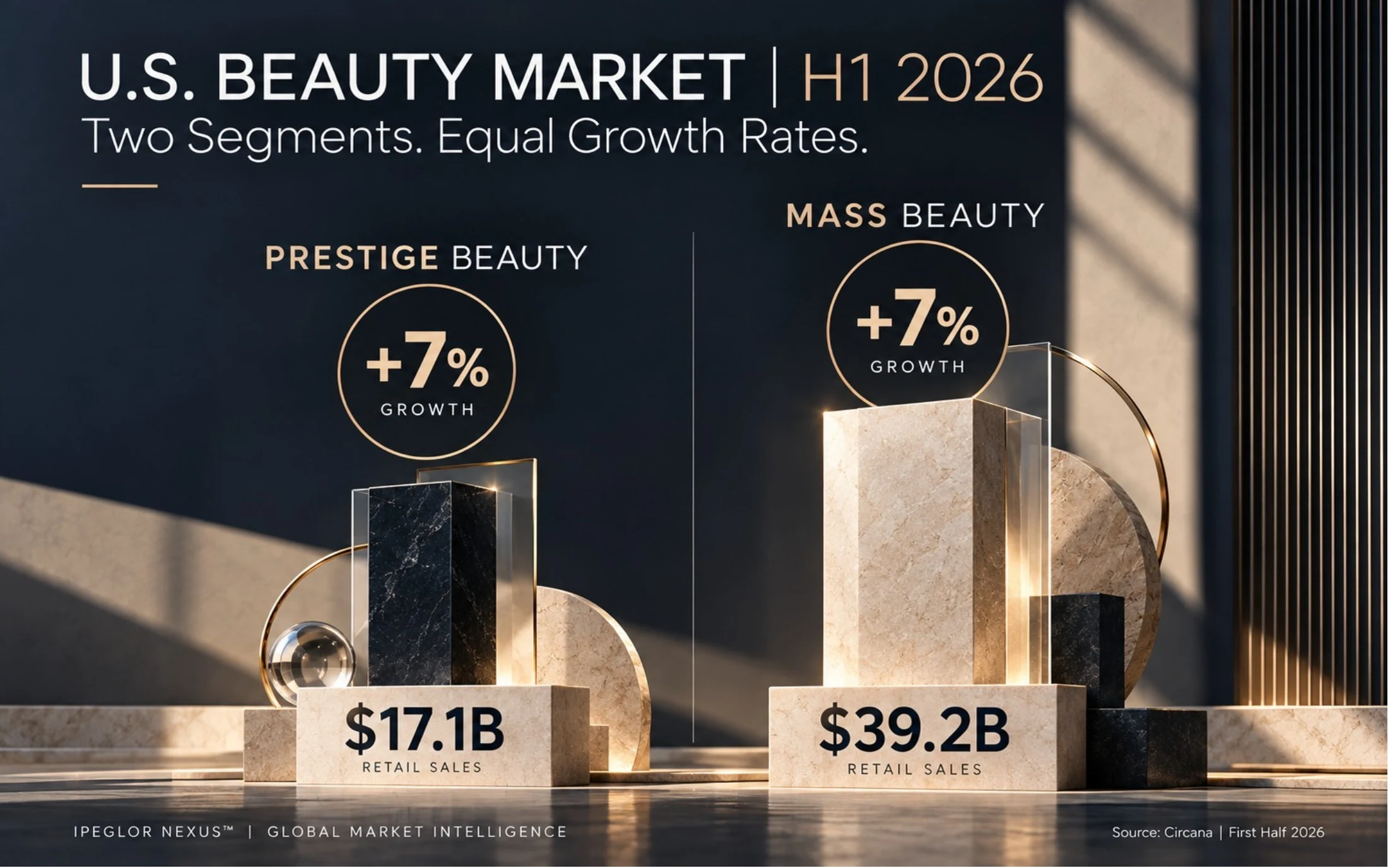
Circana reports that US prestige beauty sales increased 7% to $17.1 billion in the first half of 2026. Mass-market beauty grew by the same percentage, reaching $39.2 billion. [1]
Meanwhile, McKinsey projects approximately 5% annual growth for the global beauty market through 2030. This is a forecast, not an observed 2026 growth rate. [5]
These figures suggest that the industry's growth potential remains substantial.
But they also raise a more important commercial question:
If the beauty market is expanding, why are some of its established brands struggling to grow?
The answer lies in understanding that market growth and competitive success are no longer interchangeable.
The End of a Simple Mass-versus-Prestige Narrative
For years, beauty market discussions have frequently centered on the distinction between mass-market accessibility and premium positioning.
The 2026 evidence suggests a more complex reality.
Both mass and prestige are growing, but consumers are becoming increasingly selective about where they spend.
Some consumers are prepared to pay more for products that deliver distinctive performance, desirable experiences, or emotional value. Others are finding comparable satisfaction in more accessible alternatives.
Importantly, these purchasing behaviors can coexist within the same consumer's beauty routine.
The distinction is not necessarily between consumers who prefer expensive products and those who prefer affordable ones.
It is increasingly between purchases that consumers consider worthwhile and those they do not.
This creates opportunities across multiple price segments.
However, it also places additional pressure on brands whose price positioning is not supported by a convincing value proposition.
For manufacturers and brand owners, the strategic implication is clear: price positioning alone is an increasingly incomplete form of differentiation.
Category Growth Is Becoming More Selective
The overall strength of the beauty industry conceals significant differences between product categories.
According to Circana, prestige skincare sales in the United States increased 9% during the first half of 2026, supported by strength in areas including body care and sun protection.
Prestige haircare grew 11%, with treatments playing an important role in category performance.
Fragrance presents another compelling example.
US mass-market fragrance sales increased 15%, while prestige fragrance grew 6% in value. [1]
These developments indicate that consumers continue to engage with beauty, but growth is concentrated in particular categories, product benefits, and purchasing occasions.
For brand owners, the opportunity is not simply to participate in a growing industry.
It is to identify where demand is strengthening, why it is strengthening, and whether their product portfolios are positioned to capture that demand.
A broad portfolio may create market coverage, but it does not automatically create competitive advantage.
The strategic value of a product portfolio lies increasingly in the relevance and incremental contribution of its individual products.
Dermatological Beauty Offers an Important Market Signal
The performance of dermatological beauty is among the most significant developments in the current market.
L'Oréal reported 10.6% adjusted like-for-like growth for its Dermatological Beauty division during the first half of 2026, compared with 6.5% for the group overall. [2]
Within Beiersdorf, the Derma business, which includes Eucerin and Aquaphor, recorded 7.8% organic sales growth over the same period.
By contrast, NIVEA, including Labello, reported a 6.8% organic sales decline. [3]
The distinction requires careful interpretation.
Beiersdorf attributed part of NIVEA's decline to temporary disruptions affecting sales into retail channels, including destocking, customer-related issues, seasonal conditions, and the timing of innovation launches.
The company also stated that NIVEA's sell-out performance remained positive during the period. Consequently, declining reported brand sales should not automatically be interpreted as declining consumer demand. [3]
Nevertheless, the contrast between dermatological and conventional skincare portfolios deserves strategic attention.
It suggests an opportunity to examine the growing commercial importance of products positioned around specific skin concerns, recognizable benefits, and credible performance expectations.
This does not establish that dermatological positioning alone causes superior growth. Brand execution, distribution, innovation, geographical exposure, and commercial conditions remain significant variables.
What it does suggest is that the relationship between product functionality and perceived consumer value deserves greater attention.
For the cosmetics industry, credible performance is becoming an increasingly important part of commercial differentiation.
Not All Revenue Growth Reflects the Same Consumer Behavior
Another important development in 2026 concerns the composition of market growth.
Revenue can increase because more products are sold, because consumers pay higher prices, because the product mix shifts toward higher-value offerings, or through a combination of these factors.
These drivers should not be treated as equivalent.
Circana's US fragrance data provides a useful illustration.
During the first half of 2026, prestige fragrance sales increased 6% in value, while unit sales remained flat. Average prices increased by approximately 5%.
In mass-market fragrance, sales value increased 15%, alongside 7% growth in units. [1]
Both segments recorded strong value growth, but the underlying commercial dynamics differed.
For business leaders, this distinction is fundamental.
A brand increasing revenue through premiumization may have a very different competitive position from one expanding its customer base or increasing purchase frequency.
Neither model is inherently superior.
Their sustainability depends on consumer retention, pricing elasticity, margins, competitive conditions, and the ability to maintain perceived value.
The industry therefore needs to evaluate growth through a more complete set of indicators.
Revenue alone cannot explain whether a business is becoming more competitive.
Distribution Is Reshaping the Economics of Beauty
Distribution has become one of the most consequential dimensions of beauty industry competition.

According to NielsenIQ's Global Beauty Views 2026, global beauty e-commerce value sales grew 18% in 2025, significantly outperforming offline growth. [4]
L'Oréal also reported double-digit e-commerce growth in the first half of 2026, at nearly twice the rate of its referenced market benchmark. [2]
These developments reflect the growing importance of digital channels in product discovery, consumer evaluation, and purchasing decisions.
However, digital growth does not eliminate the strategic relevance of physical retail.
LVMH's third-quarter 2026 results provide an illustration of differing performance across business activities.
Its Selective Retailing division achieved 8% organic revenue growth during the quarter, while Perfumes & Cosmetics recorded 1% growth.
For the first nine months of 2026, the corresponding figures were 6% growth for Selective Retailing and broadly flat organic revenue for Perfumes & Cosmetics. [6]
These business groups have different operating models and scopes, so their performance should not be interpreted as a direct comparison of retail channels against beauty brands.
Nevertheless, Sephora's reported momentum within Selective Retailing illustrates the commercial importance of strong retail platforms. [6]
For cosmetics businesses, channel strategy now extends beyond securing distribution.
It influences consumer acquisition, brand visibility, pricing discipline, education, repeat purchasing, and long-term profitability.
The challenge is not simply to be present across multiple channels.
It is to understand the distinct economic contribution of each.
Global Opportunity Demands Local Market Intelligence
Beauty industry growth is global in scope, but its commercial dynamics remain highly regional.
NielsenIQ's 2026 analysis, drawing on insights from 20 major beauty markets, highlights significant differences in consumer expectations, digital behavior, purchasing priorities, and local market conditions. [4]
L'Oréal's first-half results offer another illustration.
Its SAPMENA–Sub-Saharan Africa region achieved 13.8% adjusted like-for-like growth, substantially above the group's overall performance. [2]
This is a company-specific regional growth figure, not an estimate of growth across the entire regional cosmetics market.
Still, it demonstrates the importance of understanding differences in regional business performance.
For international cosmetics companies, market expansion requires more than translating product labels or transferring an existing assortment into another country.
It involves understanding local purchasing power, consumer expectations, category maturity, regulatory requirements, competitive intensity, and distribution economics.
Even within geographically connected markets, these conditions can vary considerably.
A global brand strategy can establish consistency. Local market intelligence determines relevance.
The ability to balance both is becoming a critical organizational capability.
What the 2026 Market Means for Beauty Businesses
The available evidence points toward a shift in how cosmetics companies should evaluate commercial opportunity.
Growth cannot be understood through market size or category momentum alone.
It requires examining how several strategic dimensions interact:
- Consumer value:
- Does the product address a meaningful need or purchasing motivation?
- Product relevance:
- Is the offering sufficiently differentiated, and are its promised benefits credible?
- Portfolio contribution:
- Does an innovation generate incremental demand, or simply redistribute existing sales?
- Channel performance:
- Do distribution choices support sustainable acquisition, conversion, and profitability?
- Market specificity:
- Is the commercial proposition appropriate for the economic, cultural, and competitive conditions of the target market?
These questions are relevant to multinational corporations, emerging beauty brands, contract manufacturers, distributors, and investors alike.
They also suggest a different approach to innovation.
Launching additional products, entering more markets, or increasing promotional expenditure should not automatically be treated as evidence of progress.
Their contribution must be evaluated in relation to actual business performance.
The objective is not growth activity. It is sustainable value creation.
Growth Is an Opportunity. Competitiveness Is a Capability.
The 2026 beauty market is not sending a simple message about the superiority of mass-market affordability or premium positioning.
Nor does it suggest that any single product category, technology, or distribution channel will define the industry's future.
Instead, the available evidence points toward a more demanding competitive environment.
Consumers continue to spend on beauty, but their choices are increasingly influenced by perceived value, relevant benefits, shopping convenience, and credible differentiation.
Brands and retailers can grow within the same market at very different rates because they do not necessarily compete with the same portfolios, customer relationships, distribution capabilities, or operating economics.
For decision-makers, this changes the central strategic question.
It is no longer enough to ask: How fast is the beauty market growing?
The more consequential question is:
What allows a business to capture that growth consistently, profitably, and sustainably?
The answer will differ across categories, brands, and geographies.
But one principle is becoming increasingly difficult to ignore:
A growing market creates opportunity. It does not create competitive advantage.
That distinction may be one of the most important lessons of the global cosmetics industry in 2026.
Research Sources
Circana. US Beauty Industry Posts Solid First-Half Growth as Fragrance and Skincare Lead Across Prestige and Mass Retail. August 11, 2026.
Official sourceL’Oréal Groupe. 2026 Half-Year Results. July 29, 2026.
Official sourceBeiersdorf AG. Half-year results 2026: Derma outperformance continues, NIVEA enters next phase of rebalancing. August 3, 2026.
Official sourceNielsenIQ. Beauty in 2026: Global shifts. Local realities. Real growth. April 6, 2026.
Official sourceMcKinsey & Company. From aisle to algorithm: The beauty categories, channels, and concepts shaping 2030 growth. June 18, 2026.
Official sourceLVMH. Continued growth in the third quarter of 2026. October 12, 2026.
Official source
Editorial methodology: This analysis combines independent market research, retail measurement data, and publicly disclosed corporate financial results. Differences in geographical coverage, reporting methodologies, and business definitions are recognized. Strategic interpretations represent the independent editorial analysis of IPEGLOR NEXUS™ and should not be read as demonstrated causal relationships.
NX-MI-001 • IPEGLOR NEXUS™ Editorial Team • 2026
© 2026 IPEGLOR NEXUS™. All rights reserved.
Featured framework
Structural Hair Resilience™
A framework for developing hair care around fibre condition and performance through repeated stress.
Explore the FrameworkSome opportunities begin with an answer Others begin with a better question
Whether you are seeking a specific ingredient, exploring a product or technology, or developing a wider partnership or market opportunity, a conversation with Nexus may be the right place to begin.
Begin a Conversation